
How To Set Your Child Up For Success - In 6 Ways


One of THE BEST WAYS to develop independence and confidence in your child is to set up their environment properly.
In the classroom, this means:
- The child's environment is accessible.
Tools and materials are child-sized, from utensils and cleaning cloths to scissors and small brooms, so children can use them safely and successfully. -
The materials are engaging.
The materials are meant to meet the child where they're at, considering their interests and abilities. A skill is not taught just because they're a certain age.
The pace of learning is also determined by the child. Children are encouraged to repeat activities as many times as they like, recognizing that with each repetition, a child is refining their skills and learning something new.
-
Skills are taught logically.
New skills are taught one step at a time, where each new skill is built on another (known as scaffolding in education). This careful preparation ensures that each child experiences real success, which builds self-esteem and encourages further exploration.
The good news is that you can do all of this at home - quite easily!
How To Set Your Child Up For Success - In 6 Ways
1. Make the home environment accessible
In a Montessori classroom, you’ll see open, low shelves so that children can access their activities independently, like these ones >>>
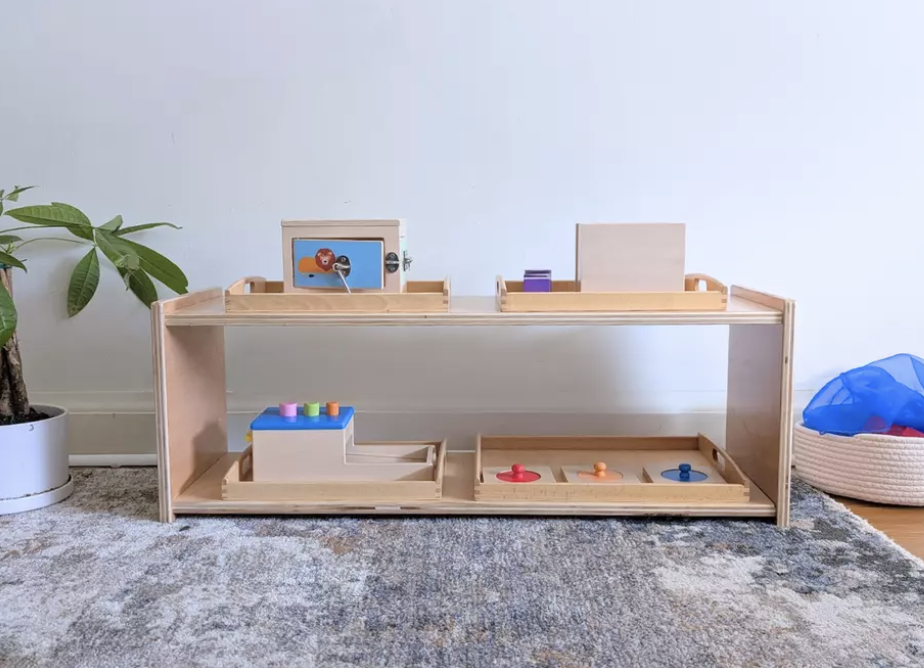
As early as infancy, low shelves are set up so that even an infant lying on the floor would be able to see what’s available from a short distance away.
The materials available to your child should always be safe to be explored independently, allowing the child freedom to explore them in a way most meaningful to them.
2. Believe your child can do it (or eventually will be able to)
Show confidence in their abilities, and recognize that with time and practice, they will learn. If they show an interest in something, try to figure out how you can teach them the skill.
3. Provide child-size tools
This includes cups, utensils, or cleaning tools that fit their hands make independence possible.
4. Demonstrate
Show how something is done, then step back and let your child try.
5. Break tasks down into small steps
One step at a time is easier to manage and builds confidence. Master one step and then move on to the next.
6. Give them time
Allow your child to explore, practice and complete tasks at their own pace. Childhood isn’t a race; it’s an important period of life where children are naturally drawn to learning new skills, a variety of new skills.
They can learn so much if you follow their interests and make learning possible for them.











![Kidamento Kidamento Children's Cameras [3 Models]](http://themontessoriroom.com/cdn/shop/products/kidamento-childrens-cameras-3-models-661353.png?v=1699075281&width=1600)
![Kidamento Kidamento Children's Cameras [3 Models]](http://themontessoriroom.com/cdn/shop/products/kidamento-childrens-cameras-3-models-661353_2000x.png?v=1699075281)

