
Fun Ways To Teach Your Child About Money


With the rise in tap pay and credit card use, children today aren’t exposed to cash as frequently as we were growing up.
And as I’ve discussed before, young children are concrete thinkers. Seeing everyone around them tapping their cards to pay for things, rather than exchanging money, is taking away the concrete aspect of money.
To learn about money, children need to touch, count, and see money as a real object, not just numbers on a screen.
And since real life modelling is less likely to happen, you can incorporate money into pretend play. This gives very young children the opportunity to learn through experience.
When your child’s interest in pretend play starts, role play situations where money is exchanged.
- Set up a pretend grocery store, toy store or farmers' market in your playroom. I suggest toy store because you can use all the toys you already have, just pretend you or your child are "buying" them. A grocery store or farmers’ market is great if you have pretend food.
- Play restaurant with a menu that includes prices.
- Put on a show and sell tickets and snacks.
Adding a toy cash register or pretend money can help make the experience more realistic for them.
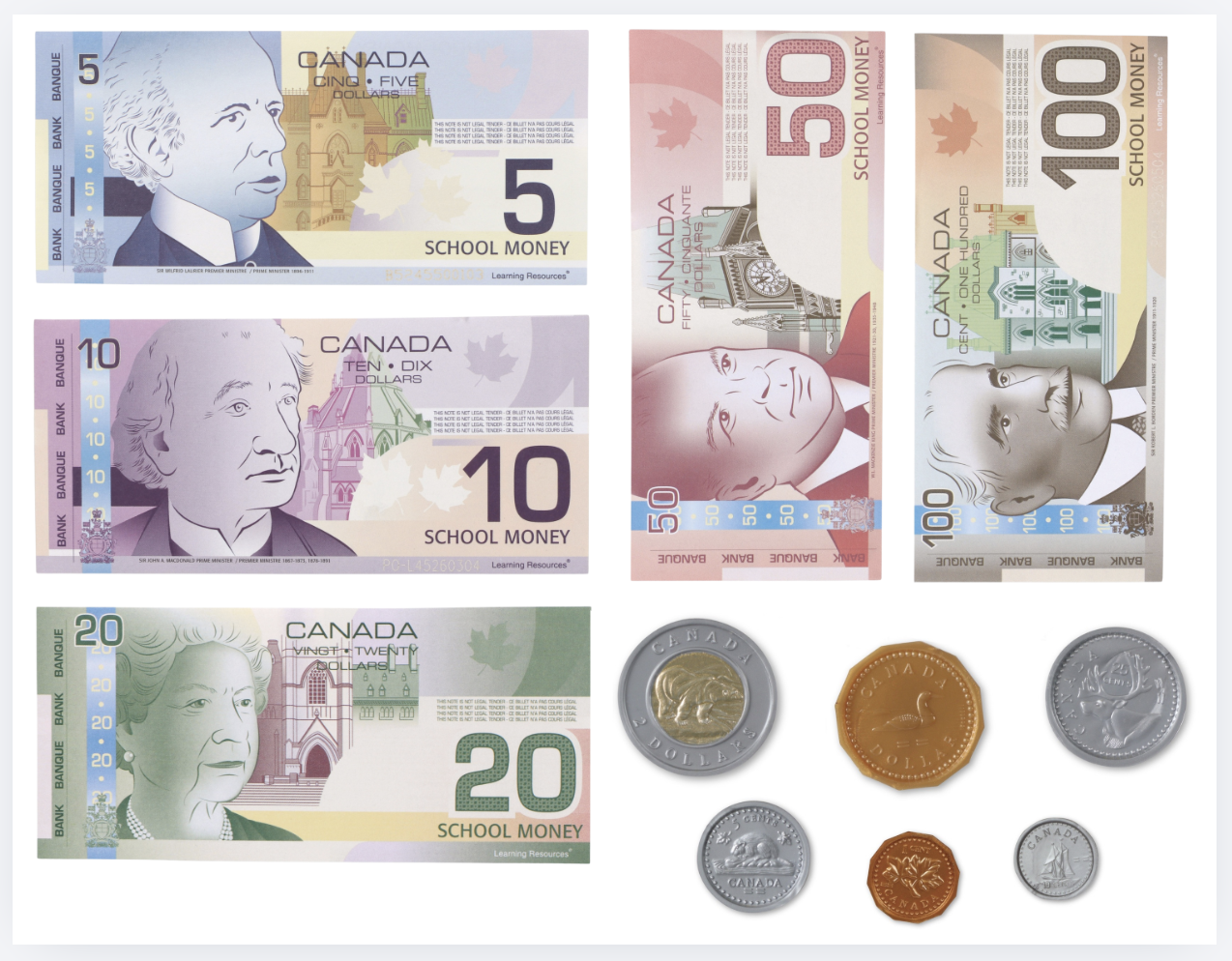
For our Canadian readers, the Hape Cash Register or Learning Resources Cash Register and Canadian Currency Activity Set includes replica Canadian money so your child can practice with accurate currency.
You can also download and laminate this page of pretend money.
Birthday Party Idea
Some parents are now opting to ask for small cash gifts at birthday parties, like $2 in a card, instead of toys/gifts. This gives children the opportunity to save and decide what to buy.
This teaches a few very practical lessons about:
- how much things cost
- how to save toward a goal
- how to make decisions with money
The added bonus is that it's less financial pressure on the birthday party guests.
Money Learning Activities for Children 5+
As your child grows, you can also:
- Give a small allowance and help your child divide their money into spending, saving, and giving. Encourage saving for a specific item and track progress with a jar, chart, or spreadsheet.
- Invite your child to help plan a shopping trip with a budget, comparing prices and calculating totals.
- Teach simple banking skills, like making deposits.
- Play money-based games like Monopoly or The Game of Life to practice transactions and decision-making around money.









![Kidamento Kidamento Children's Cameras [3 Models]](http://themontessoriroom.com/cdn/shop/products/kidamento-childrens-cameras-3-models-661353.png?v=1699075281&width=1600)
![Kidamento Kidamento Children's Cameras [3 Models]](http://themontessoriroom.com/cdn/shop/products/kidamento-childrens-cameras-3-models-661353_2000x.png?v=1699075281)

