
How To Nurture Your Child's Interest in Science...


There's no better way to nurture your child's love of science and curiosity about the natural world than by being interested in those subjects yourself.
Doing things like:
- Sharing information
- Taking books out of the library about topics your child is interested in
- Looking up answers together
are all great ways to do this.
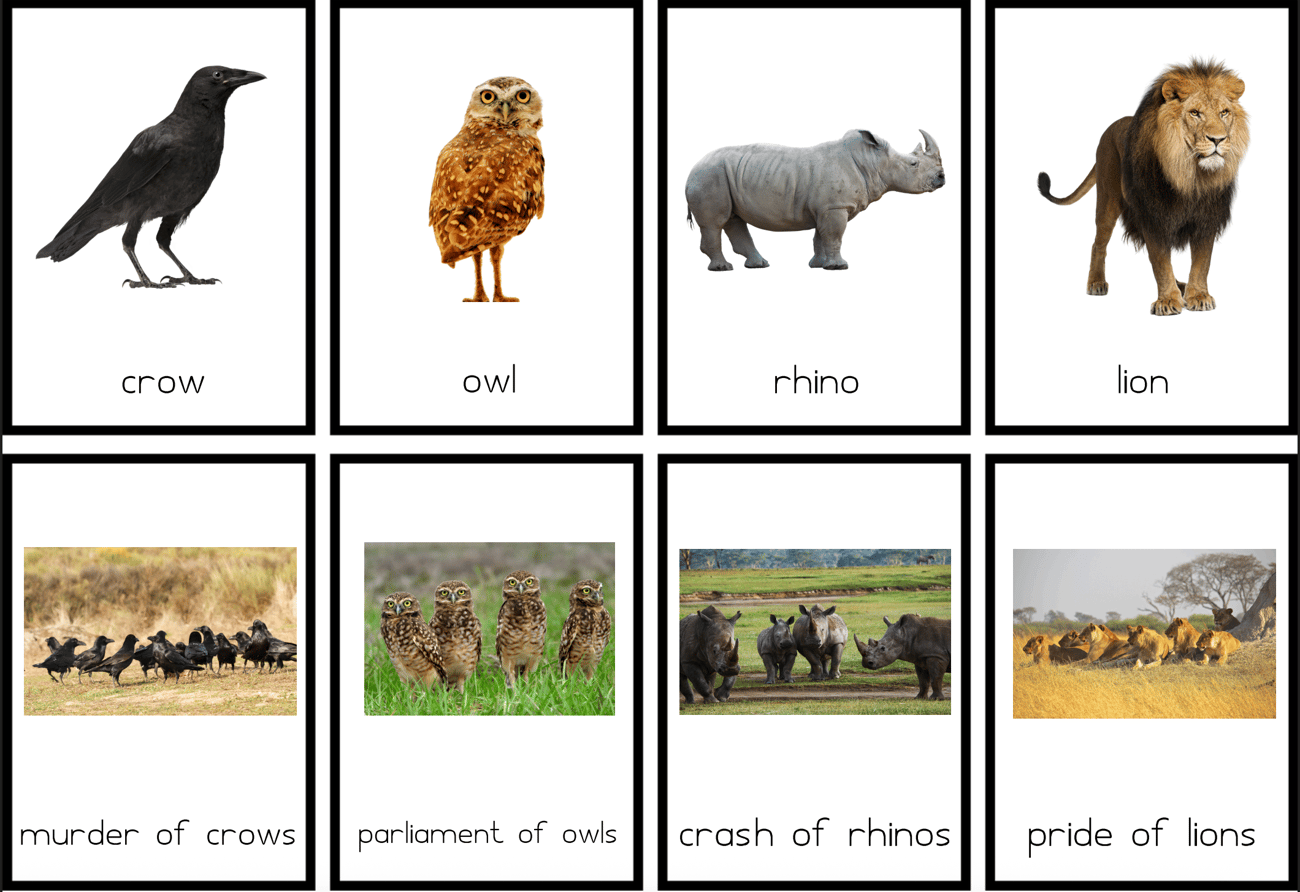
One topic that Katie (our Infant and Toddler Montessori teacher, creator of the At-Home Program) and I recently became interested in is the collective nouns for animals - a murder of crows, a parliament of owls, a crash of rhinos, etc.
There’s something about these names that feels a little surprising and often quite funny.
Group names for animals are one of those small, interesting details that tend to capture children’s attention right away.
Not only does learning these names enrich a child’s vocabulary, but for children, this kind of language sparks curiosity.
They often want to know why a group of crows is called a murder, or why flamingos are called a flamboyance.
Those questions create natural opportunities for conversation and exploration.
Activity: Match The Animal to its Group
We created an activity to learn the names of animal groups.
Recommended Age: 3 years and up
Instructions:
1. Print and cut out all of the cards, separating the single animal cards from the group name cards.
Click here to download the cards.
2. Begin by introducing the activity. Choose about five pairs of cards to start with, ideally ones that will be most interesting or engaging.
3. Sit together and look through the singular animal cards first, naming each one as you go.
4. Then look through the group name cards and read them aloud.
5. Once familiar with the cards, invite your child to begin matching. You might say, "Let’s see if we can find the group names that go with each animal."
Support as needed by reading the words together and talking through choices.
Extension
- As interest grows, rotate in new cards or add more from the set to keep the activity fresh and engaging. Follow your child’s curiosity, revisiting favourite or particularly funny group names for conversation and vocabulary building.
- This is also a great opportunity to introduce early research skills. If your child becomes curious about why a particular group of animals has its name, look it up together at the library or search online.
Cards Included:
- Crow —> A murder of crows
- Owl —> A parliament of owls
- Rhino —> A crash of rhinos
- Lion —> A pride of lions
- Monkey —> A troop of monkeys
- Giraffe —> A tower of giraffes
- Elephant —> A herd of elephants
- Flamingo —> A flamboyance of flamingos
- Dolphin —> A pod of dolphins
- Wolf —> A pack of wolves
- Goose —> A gaggle of geese
- Fish —> A school of fish
- Lemur —> A conspiracy of lemurs
- Cobra —> A quiver of cobras
- Stingray —> A fever of stingrays
- Hyena —> A cackle of hyenas
- Cheetah —> A coalition of cheetahs
- Skunk —> A stench of skunks
- Shark —> A shiver of sharks
- Porcupine —> A prickle of porcupines










![Kidamento Kidamento Children's Cameras [3 Models]](http://themontessoriroom.com/cdn/shop/products/kidamento-childrens-cameras-3-models-661353.png?v=1699075281&width=1600)
![Kidamento Kidamento Children's Cameras [3 Models]](http://themontessoriroom.com/cdn/shop/products/kidamento-childrens-cameras-3-models-661353_2000x.png?v=1699075281)

