
How To Easily Replicate The Cylinder Blocks At Home
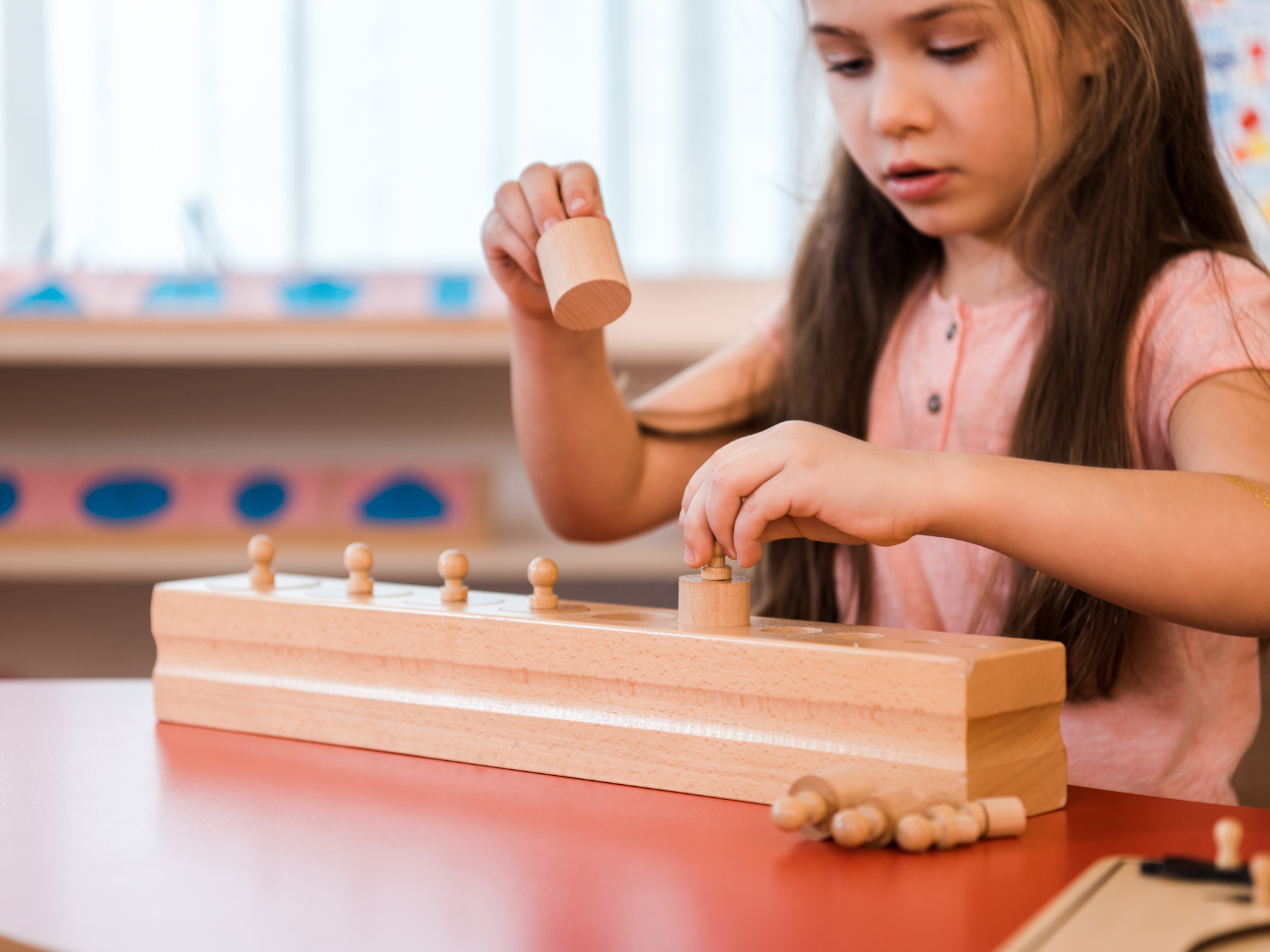


The Cylinder Blocks are one of my favourite Casa materials. They provide a wonderfully logical and thoughtful way to teach size discrimination.
If you're unfamiliar with the Cylinder Blocks, they're introduced in the Casa Classroom (ages 3 to 6 years).
Their purpose is to help children develop visual discrimination of size.
Each cylinder has a knob for the child to grasp and fits into a corresponding socket in a wooden block.
Each block contains 10 cylinders.

There are four Cylinder Blocks, each offering a different variation in dimensions:
- Block 1: Cylinders increase in both height and diameter, from small to large.
- Block 2: Cylinders increase in diameter, from thin to thick.
- Block 3: Cylinders decrease in height while increasing in diameter, from tall and thin to short and thick.
- Block 4: Cylinders increase in height from short to tall, while the diameter remains constant.
The child removes the cylinders from the block and then replaces each one in its corresponding socket.
Through this work, the child refines their ability to visually discriminate differences in dimension while also developing concentration and coordination.
How To Easily Replicate The Cylinder Blocks At Home
Knobbed Cylinders are a beautiful material for the classroom, where children can work with them as part of the Montessori Sensorial curriculum.
At home, there’s no need to purchase a set just to practise visual discrimination of size.
You can explore these same skills with everyday objects.
Choose several similar objects and invite your child to compare them by size. Use blocks, toy cars, nesting cups, containers, stuffies or natural objects like rocks, sticks, and pinecones. Then invite them to:
- Find two objects that are the same size
- Find the tallest or shortest object
- Find the widest or narrowest object
- Arrange objects from smallest to largest
- Arrange objects from shortest to tallest
You can make a game of it and explore together.
Working together is a great way to naturally invite conversation and enrich their vocabulary.
Words like big, small, tall, short, wide, narrow, thick, and thin give children the language to describe what they are noticing.
It’s worth noting that children are also naturally developing their visual discrimination skills through play all the time. Building towers with blocks, using nesting toys and working with puzzles all give children opportunities to compare size and figure out what fits where.










![Kidamento Kidamento Children's Cameras [3 Models]](http://themontessoriroom.com/cdn/shop/products/kidamento-childrens-cameras-3-models-661353.png?v=1699075281&width=1600)
![Kidamento Kidamento Children's Cameras [3 Models]](http://themontessoriroom.com/cdn/shop/products/kidamento-childrens-cameras-3-models-661353_2000x.png?v=1699075281)

