
Fantasy vs. Reality in the Montessori Classroom
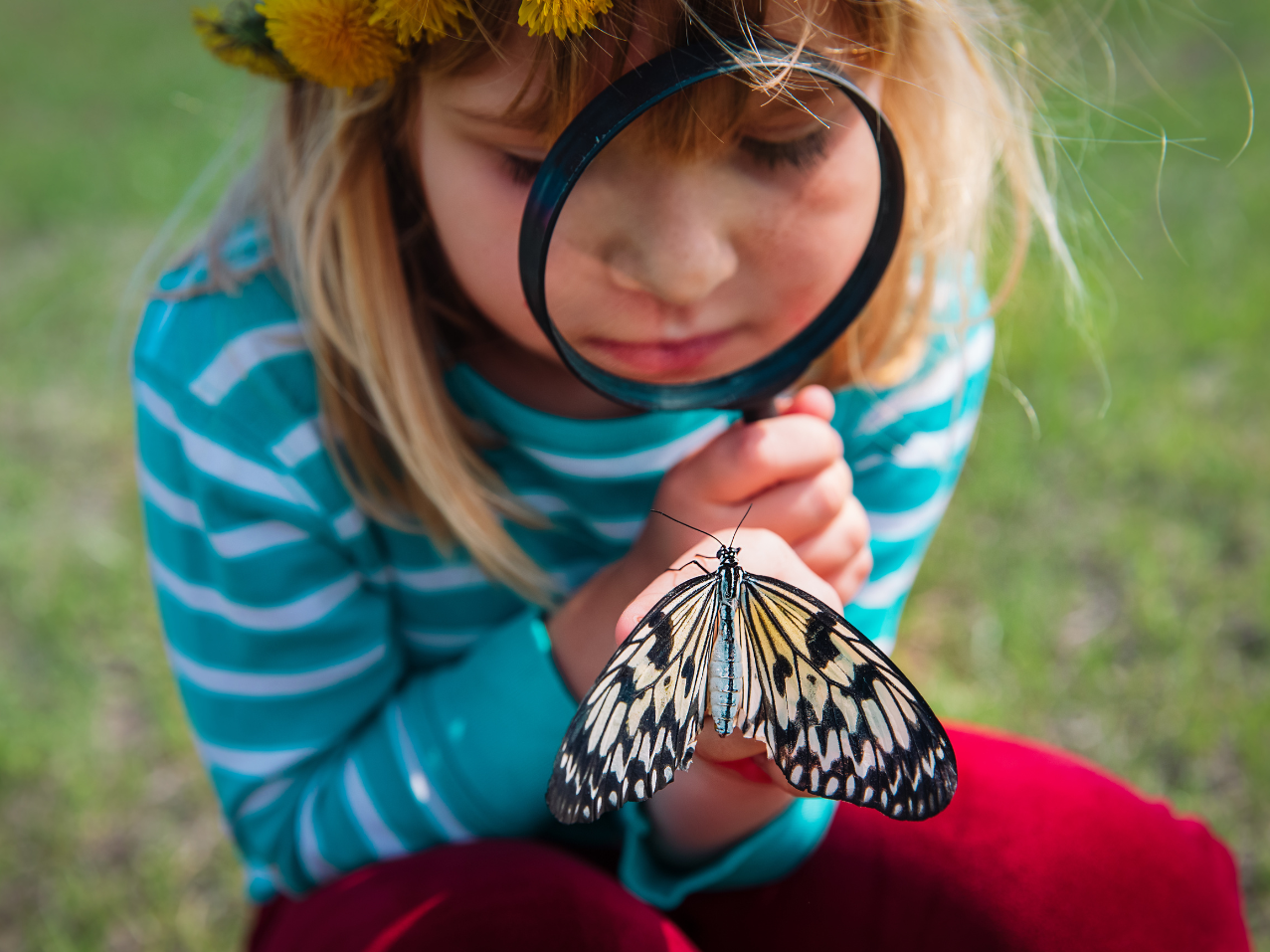

Montessori believes the early years are for the concrete. Dr. Montessori believed that children need a firm understanding of the real world, before introducing fantasy, like dragons, fairies, and talking animals.
It's only once children reach middle childhood (ages ~6-12), that they are exposed to fantasy and the abstract (i.e. a watercolour image of the planets versus real photos), as a way to develop their imagination and creativity.
But while they're young, focusing on the concrete helps them to understand the world around them and consequently, feel more confident in it.
Nature and Early Childhood
Nature is meaningful for young children to learn about because it is part of the world they experience every day.
Children naturally observe the world around them, noticing the trees, sky, clouds, water and other elements of nature. These everyday experiences create meaningful opportunities to introduce new vocabulary and help children build a connection with their environment.

In the Montessori classroom, 3-Part Nomenclature Cards help children move from the concrete to the abstract by connecting a real object with its picture and name.
For example, a child may recognize a leaf they find outside, but may not know that different leaves have different names or characteristics. A picture of a leaf helps them connect the object they see in the natural world with the language used to describe it.
In the Montessori classroom, 3-Part Nomenclature Cards help children move from the concrete to the abstract by connecting a real object with its picture and name.
For example, a child may recognize a leaf they find outside, but may not know that different leaves have different names or characteristics. A picture of a leaf helps them connect the object they see in the natural world with the language used to describe it.
Real photos are especially helpful for nature vocabulary because they show children accurate details and help them recognize objects as they appear in the real world.
Nature is also a wonderful way to encourage observation and classification. Children begin to notice similarities and differences between natural objects and understand that things in the world can be grouped and organized.
Language cards help children:
- learn the names of natural objects and elements
- enrich their vocabulary through meaningful, real-world experiences
- strengthen their understanding that images represent real objects in the world
- begin to recognize similarities, differences and categories within the natural world
We’ve created a nature-themed bundle of language cards to explore with your child:
The Three Elements cards also include a sorting activity to help children explore and classify examples of land, water and air.
Here are instructions on how to use the cards: How to Present 3-Part Language Cards.
Extension Activity in Nature
As an extension, these cards can be matched with real objects found in nature, such as leaves or shells collected outdoors. This gives children the opportunity to connect the picture and word with a real-life object.
Stay tuned for Toddler versions of all our Nomenclature Cards. They’ll be larger and without any text.
You can also find our entire collection of 3-Part Nomenclature Cards in this folder here.









![Kidamento Kidamento Children's Cameras [3 Models]](http://themontessoriroom.com/cdn/shop/products/kidamento-childrens-cameras-3-models-661353.png?v=1699075281&width=1600)
![Kidamento Kidamento Children's Cameras [3 Models]](http://themontessoriroom.com/cdn/shop/products/kidamento-childrens-cameras-3-models-661353_2000x.png?v=1699075281)

