What are the Montessori Bead Materials?
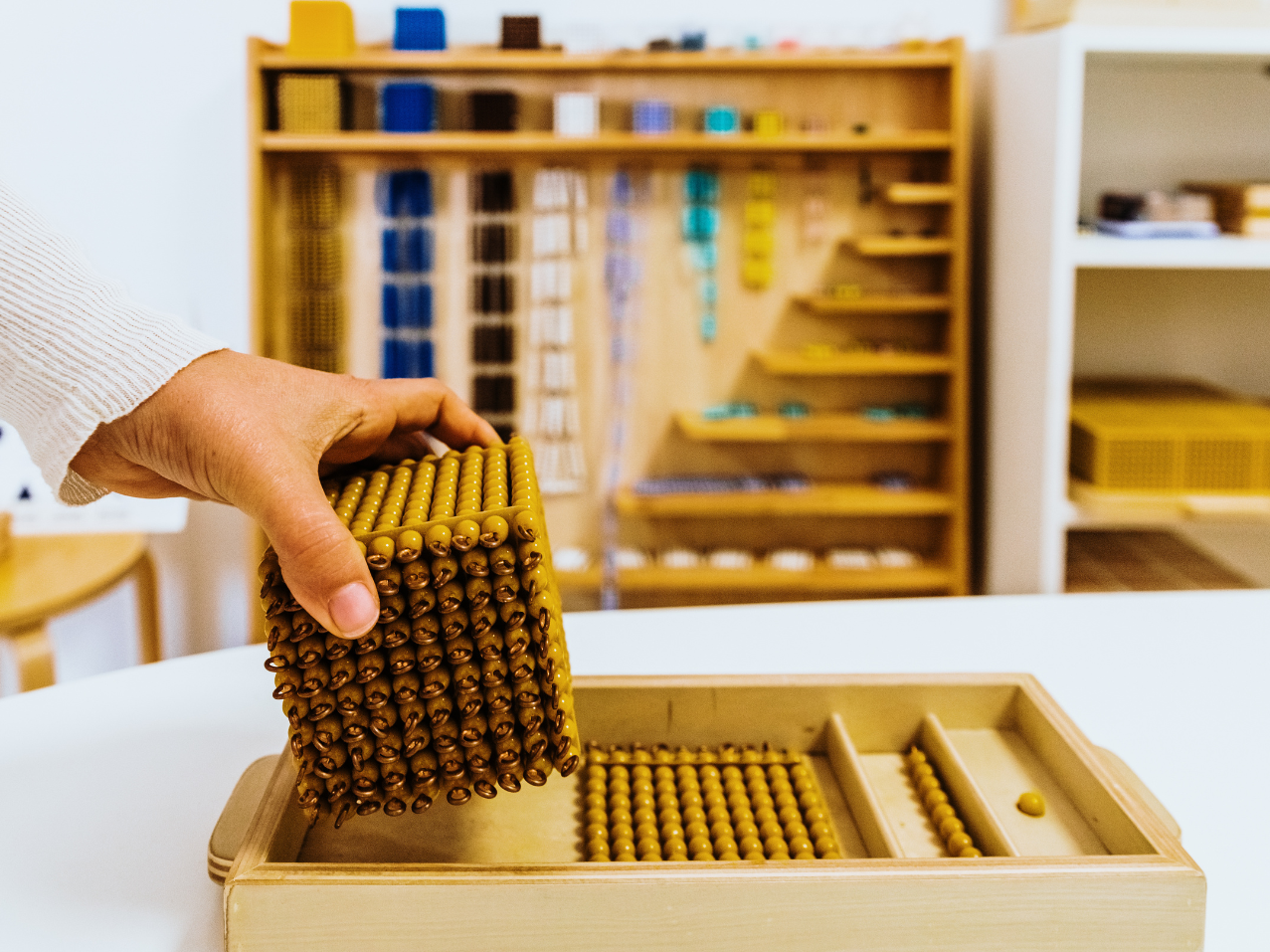

We get a lot of questions from parents and those new to Montessori about this strange set up >>>

This is the Montessori Bead Material in its specialized Bead Cabinet.
And to make it more complicated, this is NOT the only bead set up in the classroom.
However, they are an amazing part of the Montessori Casa math curriculum, introduced at age three.
They give children a hands-on way to explore numbers and mathematical relationships before moving to more abstract work.
The Three Montessori Bead Materials
Coloured Bead Bars

Bars representing quantities 1-10. Each quantity is represented by a specific colour, helping children to visually recognize and distinguish the different quantities. Children use them to practise counting, recognize quantities, and explore simple number combinations and early arithmetic.
Bead Chains

Longer arrangements of the coloured beads. Children count the beads in groups to practise skip counting, such as counting by 2s, 3s, or 4s. The chains also help children explore multiplication and see how numbers can be combined to create larger patterns, including squares and cubes.
Golden Beads

Used to introduce place value and the decimal system, and later for the four operations: addition, subtraction, multiplication, and division.
What Comes BEFORE the Bead Materials?
Before being introduced to the bead materials, children in Montessori classrooms first build an understanding of quantities and numerals using materials such as the:

The bead materials build on this foundation, giving children new ways to explore numbers, counting and arithmetic.
At-Home Alternatives
We do NOT recommend buying Montessori bead materials for home use.
These materials are part of a carefully sequenced math curriculum and they are to be introduced and used in a particular way.
Instead, recognize that the hands-on nature of the bead materials is one of the things that makes them so effective, so look for opportunities for your child to explore math with their hands at home, too.
Simple materials like counters, counting sets, loose parts, and snap cubes can give children opportunities to count, match quantities, and explore simple addition and subtraction in a very concrete way.
You can explore our collection of Math & Numeracy Toys, Games & Books here